
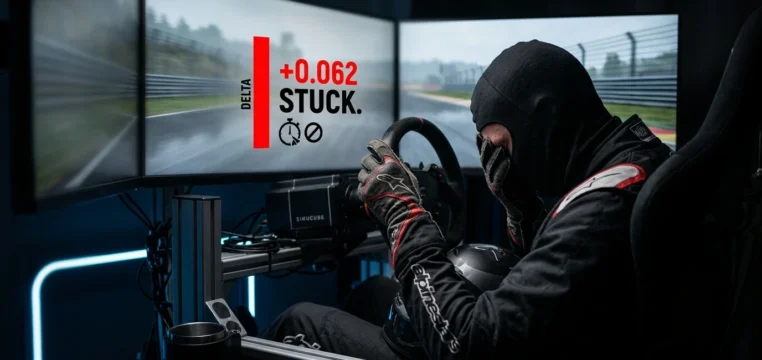
If you feel like you’re stuck, lap time sim racing performance isn’t usually down to your wheel, your pedals, or even your specific car setup. The truth is, you’re likely held back by how you drive, and unfortunately, that’s the part nobody really wants to hear.
The Plateau Nobody Talks About
Every sim racer hits this wall eventually. At the beginning, you tend to improve incredibly fast as you learn the tracks and find your lines, watching your lap times drop almost every single session. But then, suddenly, it just stops. You’re not necessarily slower, but you aren’t getting any faster either you’re just stuck.
Lap time sim racing plateaus like this are frustrating because you’re hitting the same braking points and making the same tiny mistakes lap after lap, no matter how much harder you try to push. This is exactly why I am not improving sim racing becomes the only thing on your mind, and it’s usually the point where most people start blaming their hardware.
You’re Not Slow – You’re Late
The real problem here isn’t actually your top speed, but rather your timing. Most of the time, you’re braking just a fraction too late or being a bit too aggressive on turn-in, which forces you to react to the car instead of anticipating its next move. That tiny, split-second delay might not seem like much, but it compounds through every corner until it affects your entire lap.
The ‘Late Braking’ Trap
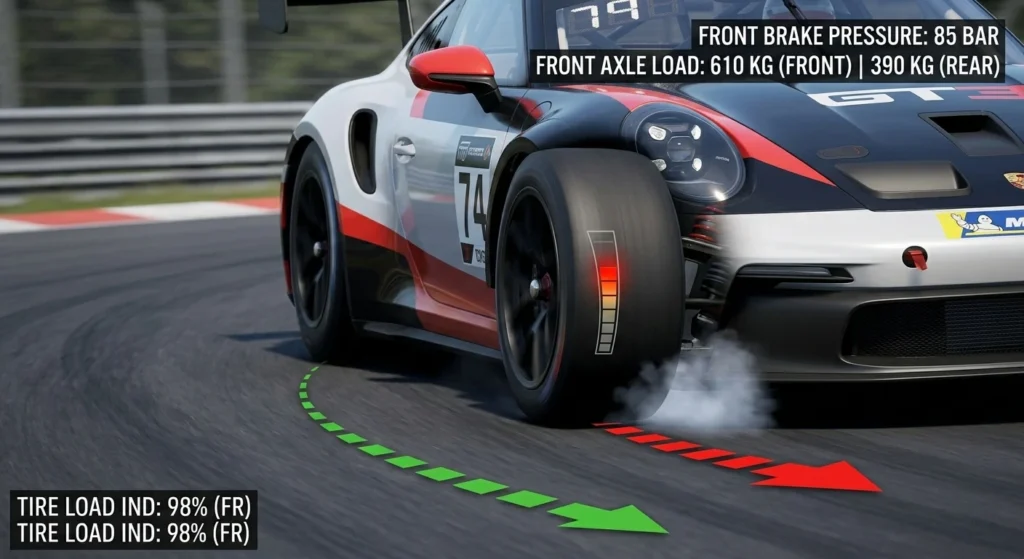
Take braking as a perfect example. You arrive at the braking zone and hit the pedal hard, maybe even later than anyone else, but because of that, you lock up slightly and have to make a tiny correction. Even if it’s subtle, you’ve already lost your entry speed. It’s one of those moments that feels incredibly fast in the cockpit, but the reality is that it’s actually costing you time.
The over-steering illusion
The same thing happens during turn-in. If you throw the car into the corner with too much steering angle, you’re essentially just scrubbing off speed and upsetting the car’s balance. Instead of a smooth arc, you end up having to fix the mistake mid-corner just to stay on track. It’s that classic situation where the car feels aggressive, and on the limit, but in reality, you’re just being slower than the driver who kept it tidy.
Where the lap time is won: The Exit
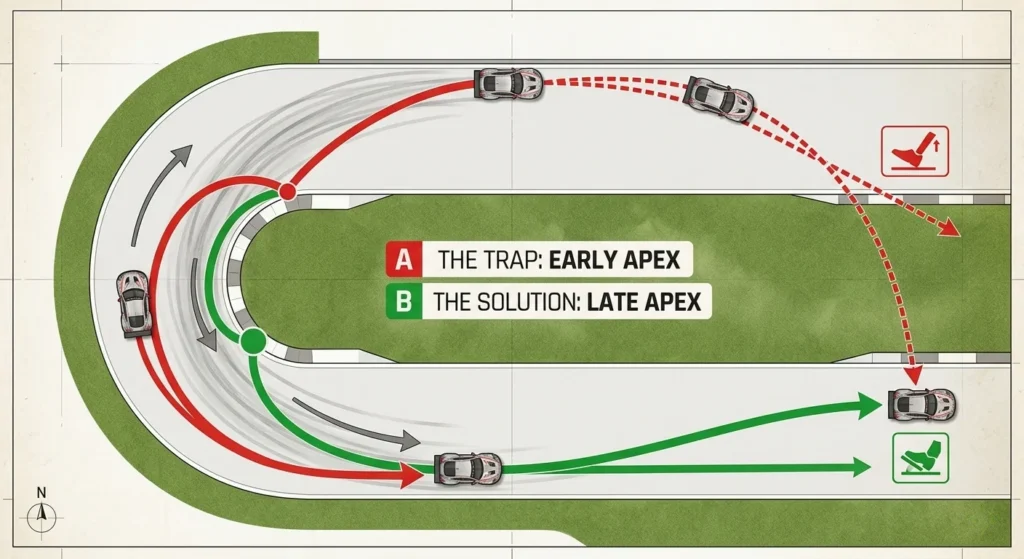
The exit is where your lap time actually lives, yet it’s where most people throw it away. If you jump on the throttle just a fraction too early, the rear gets light and forces you into a correction. Even if it’s a small one, that hesitation kills your momentum all the way down the next straight. It might feel like you’re being proactive, but by rushing the power, you’re actually sacrificing the speed that matters most
The “Pushing Harder” Trap
This is exactly where most people fall into a frustrating cycle. When you feel like you’re hitting a sim racing plateau, your instinct is usually to think, ‘I just need to push harder.’ So, you start braking even later, turning more sharply, and trying to accelerate earlier than before. But then you look at the delta and your lap time either stays the same or, even worse, starts to climb.
This happens because you aren’t actually adding speed; you’re just adding more mistakes to an already messy lap. Realizing that ‘more effort’ doesn’t always equal ‘more pace’ is the first step toward understanding why I am not improving sim racing as fast as I’d like.
The shift from effort to execution
The truth is that fast drivers don’t actually push harder, they just drive cleaner. Instead of fighting the car, they focus on braking slightly earlier to maintain total control, turning in smoother to preserve balance, and always prioritizing exit speed over everything else. They’ve developed the ability to feel what the car is doing before it even breaks traction, which allows them to anticipate its movement rather than just reacting to it. Understanding this shift in mindset is the key to what actually improves lap times in sim racing, as it moves you away from raw effort and toward a more calculated, efficient way of driving.
The Hardware Delusion
The reason many people stay stuck is that they’re simply looking at the wrong variables. It’s much easier to blame a car setup, a lack of force feedback, or aging hardware than it is to admit the problem is behind the wheel. However, no amount of torque or high-end gear will fix a fundamental lack of sim racing consistency. You can upgrade your pedals, but they won’t automatically improve your inputs or your car control; in fact, a more powerful wheelbase usually just makes your existing mistakes more obvious rather than making you faster.
The practical path to finding pace
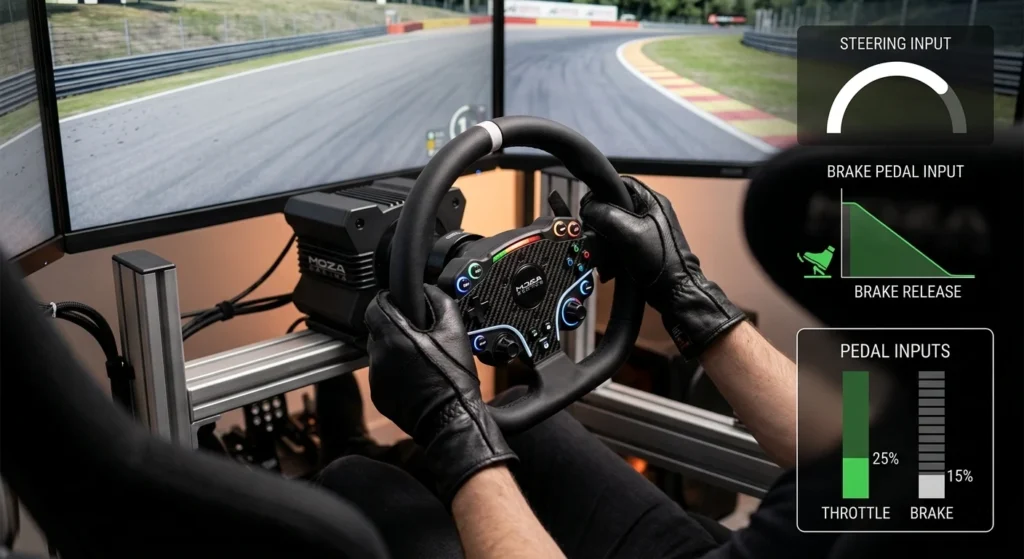
Instead of chasing the limit of your hardware, focus on what actually moves the needle. It starts with a fundamental shift: forget about late braking and prioritize a controlled, stable entry above all else. When the car is balanced, the entire corner improves. This usually requires you to consciously slow down your inputs; if your hands or feet are too aggressive, the car becomes unpredictable. By working on smoother steering and a more progressive throttle or brake release, you move from being erratic to being fast, because smoothness equals predictability.
The biggest gains, however, come from focusing on your exit speed rather than trying to be a hero on entry. Most of your lap time is lost the moment you prioritize a deep lunge over a clean, early, and controlled exit. Finally, the most effective way to break a sim racing plateau is to stop driving at 101%. When you’re constantly on the absolute limit, you’re inevitably crossing it and making tiny, time-consuming mistakes. Backing off to 95% allows you to find that elusive sim racing consistency, and as any pro will tell you, being consistent is the only real way to lower your lap times over a full stint.
The role of hardware: Clarity over speed
Don’t get me wrong: better gear is fantastic, but it won’t magically make you a faster driver. What it actually does is make the car’s behavior much clearer. A high-end wheelbase and load-cell pedals help you feel the grip levels earlier, understand weight transfer with more precision, and catch those tiny mistakes before they ruin your lap. That’s the real benefit of an upgrade, it’s about transparency, not raw pace. If you’re trying to figure out if it’s time to switch, understanding the direct drive vs belt drive comparison will help you see how different technology impacts that level of feedback.
The final shift in perspective
Ultimately, you have to realize that you’re not stuck because you lack raw speed; you’re stuck because you lack consistency. True pace is a natural byproduct of total car control, not something you can force by pushing harder or buying your way out of a plateau with better gear. When you stop fighting the wheel and start truly feeling what the car is doing underneath you, everything clicks. Once you master that connection and prioritize execution over effort, your lap times won’t just change; they’ll finally start to reflect the driver you’re actually capable of being.