
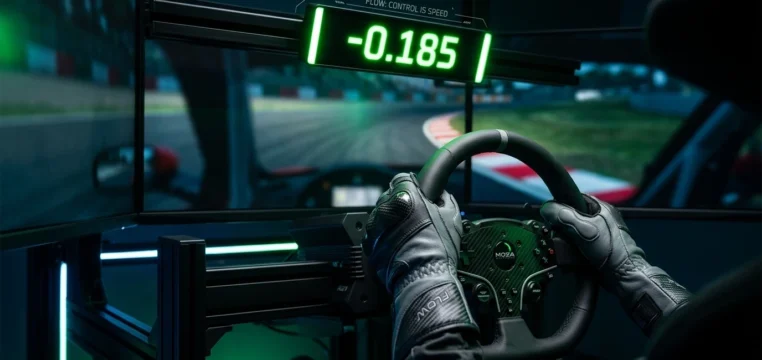
Let’s be honest: to get faster, you don’t need more raw speed; you need to master sim racing control. Most sim racers aren’t inherently slow; they are simply inconsistent, and inconsistency is the silent killer of any lap time worth recording.
Speed Is Not the Problem
You’ve already proven to yourself that you can be fast. It happened during that one clean run, that perfect corner, or that fleeting “this feels right” moment. The real issue isn’t your ability to produce a peak performance, but your inability to repeat it. When your lap times fluctuate constantly, you aren’t facing a speed limit you’re facing a control limit.
What Sim Racing Control Actually Means
True control isn’t about driving slowly or being overly cautious. On the contrary, sim racing control is the ability to make every input predictable, keeping the car’s balance stable so you know exactly what the vehicle will do before it happens. It’s the shift from reacting to what the car does to acting with intent.
Steering: The Art of Precision
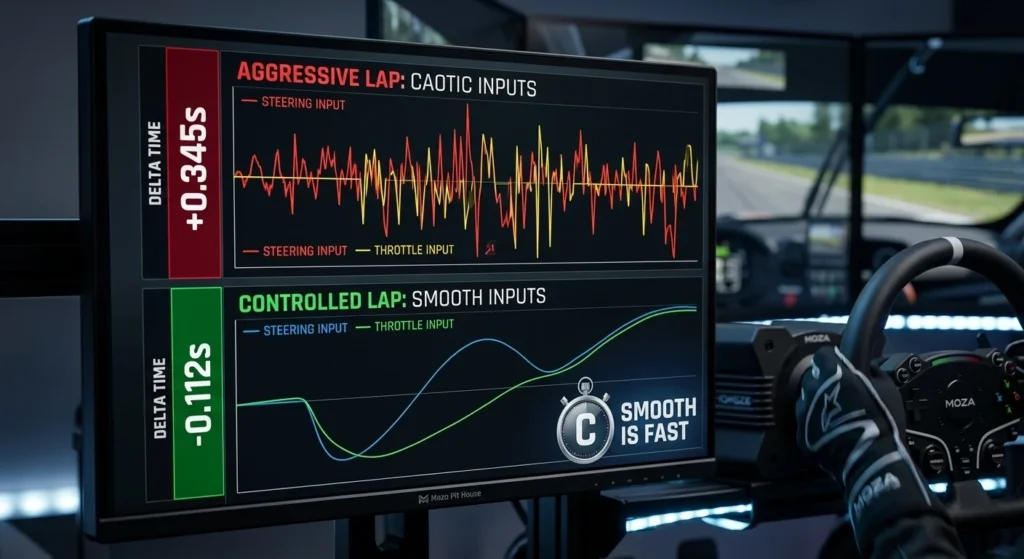
Most drivers use far too much steering, attacking the wheel with sudden movements or micro-corrections mid-corner. This prevents the car from ever settling, saturating the front tires’ grip and triggering a cycle of understeer and overcorrection that bleeds time.
Throttle: More Than an On/Off Switch
The throttle is a precision instrument, not an on/off switch. A common bad habit is rushing to 100% too early or abruptly lifting at the first sign of a slide. These sudden transitions lead to an unstable rear end and poor exits, destroying your top speed down the following straight.
Braking: Where Control Starts
Braking is where control truly takes shape. It’s not just about where you hit the brakes, but how you release them. The magic happens during trail braking; if your release is abrupt, the weight shifts too fast, the nose pops up, and you lose the car’s balance right when you need it most to rotate into the apex.

Why Smooth Drivers Are Always Faster
On track, smoothness rarely looks impressive. From the outside, a smooth driver can almost look slow, but the stopwatch tells a different story. Drivers who master smooth inputs carry more minimum speed through corners because they keep the car’s platform flat and balanced. While aggressive drivers are busy fighting the car and fixing mistakes, smooth drivers are already focused on the next exit.
Consistency Beats One Fast Lap
Anyone can fluke a “lap of a lifetime” once every hundred tries. Very few can repeat it ten times in a row. Consistency is what builds real race pace, not isolated peaks. If your laps look like a rollercoaster a 1:34.8 followed by a 1:35.6, you aren’t improving; you’re just guessing.
Deep Dive: If you feel like you’re repeating the same mistakes without progress, check out our guide on why you’re stuck at the same lap time.
Control Builds Confidence
When you truly control the car, you stop fighting it. You start trusting your inputs and committing to corners with intent rather than hope. This psychological shift is where real, sustainable pace comes from.
How to Improve Consistency: Practical Training
Forget the stopwatch for a session. Focus on these three pillars of control to improve consistency in sim racing:
- Slow Your Hands Down: Spend a few laps focusing entirely on your steering. Aim for zero sudden movements and zero mid-corner corrections. Smoothness starts with your fingertips.
- Master the Brake Release: Don’t worry about your braking point for now. Focus entirely on the transition from 100% brake to 0%. Make it a deliberate, fluid motion. You’ll feel the front end “bite” the tarmac differently.
- Delay Full Throttle: Don’t rush the exit. Build the throttle pressure progressively, ensuring the car is stable before demanding maximum power. Your exit speed will improve naturally.
- Target the “Five-in-a-Row”: Aim to put together five clean laps within two-tenths of each other. Use the same lines, the same braking points, and the same inputs. This is how you build a professional pace.
Where Hardware Helps (But Doesn’t Fix You)
Let’s be clear: better hardware won’t fix bad driving habits. However, high-end gear allows you to feel the limit of grip and weight transfer much earlier. That clarity makes it significantly easier to provide the smooth driving inputs required to stay on the limit without crossing it.
Learn More: To understand how technology impacts your feel for the car, see our Direct Drive vs Belt Drive comparison.
Final Insight
Speed is not what you lack; it is the natural byproduct of control. Once you fix your inputs and master the car’s balance, the speed will follow automatically without you ever having to force it.