
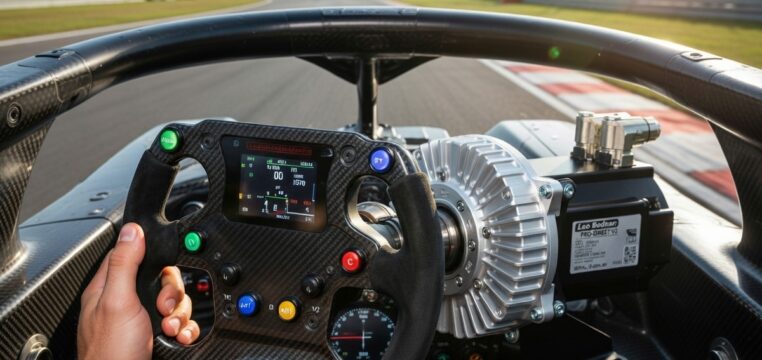
Most sim racing beginners start their journey with gear-driven or belt-driven wheels. They are great entry points, but there always comes a moment when something feels…off. It’s that “rubber band” sensation in the corners, the muffled details, or that split-second delay when you’re desperately trying to catch a slide before it ends your race.
This is exactly where most drivers hit a performance wall. When your wheel stops communicating clearly, you start guessing instead of reacting. That is precisely why a direct drive wheel is the most significant upgrade you can make to your rig. It’s not just about power; it’s about clarity.
If you want to see which models are actually worth your investment right now without wasting money on marketing hype, I’ve broken down the top picks here: 👉 Best Direct Drive Wheels Under $1000
WHAT IS A DIRECT DRIVE WHEEL?
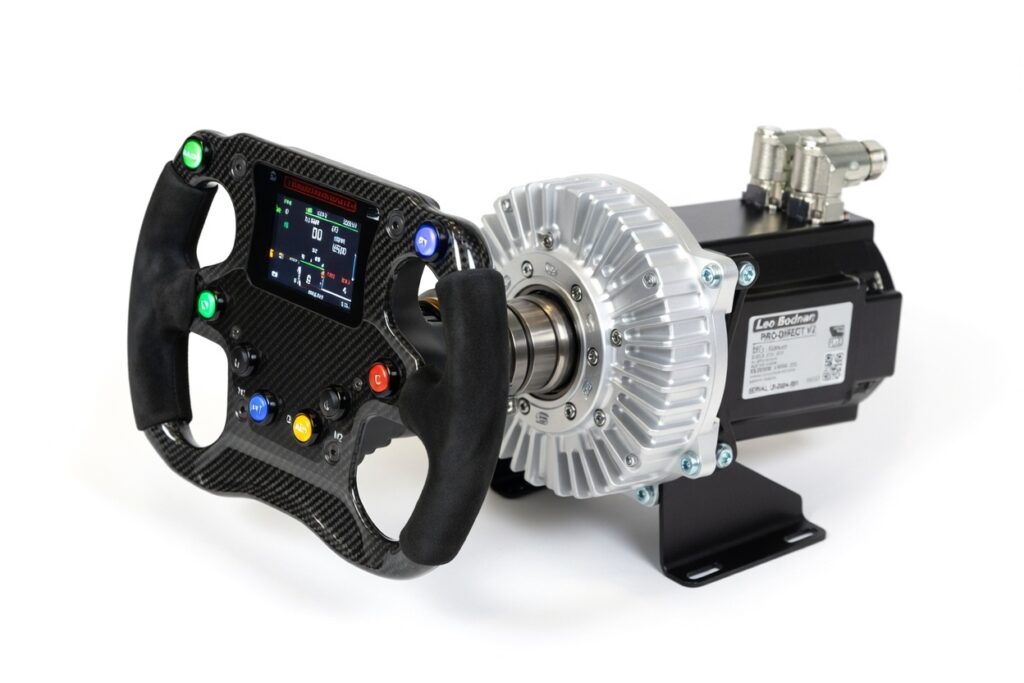
To put it simply: a direct drive wheel is a system where the steering rim is mounted directly onto the motor’s shaft. Unlike traditional setups, there are no belts, no gears, and no intermediate parts to filter the signal. The relationship is pure: Motor → Steering Wheel → Your Hands.
This mechanical simplicity allows for near-instantaneous response times and incredibly nuanced Force Feedback (FFB). Every curb vibration, every dip in the asphalt, and most importantly the exact moment your front tires lose grip is transmitted to your palms without delay. It eliminates the “toy-like” feel of entry-level systems and replaces it with automotive-grade precision.
HOW IS IT DIFFERENT FROM NORMAL WHEELS?
To understand why direct drive wheel explained in technical terms matters, we have to look at what’s happening “under the hood” of standard wheels. Entry-level systems like Logitech (G29/G923) use gears, while mid-range options like the Thrustmaster T300 use belts. These systems inherently introduce friction and mechanical slop, which “smears” the fine details provided by the sim’s physics engine.
Simple comparison:
| Type | Feeling | Precision | Noise | Realism |
| Gear-driven | Rough | Low | Loud | Low |
| Belt-driven | Smooth | Medium | Quiet | Medium |
| Direct Drive | Raw & detailed | Very high | Silent | Very high |
WHY DO PEOPLE SWITCH TO DIRECT DRIVE?
BecSwitching to a sim racing direct drive wheel isn’t just about getting a stronger motor that can rip the wheel out of your hands. The real revolution is the quality of the information. With a DD motor, you can “read” the car’s balance through your fingertips.
This isn’t just for immersion; it’s for consistency. Understanding weight transfer in real-time means making fewer mistakes, saving your tires from overheating, and ultimately finding those extra tenths of a second. This is why professional Formula-style sim setups are built exclusively around direct drive technology: at that level, precision is everything.
IS DIRECT DRIVE ONLY FOR PROS?
There’s a common myth that Direct Drive is a luxury reserved for eSports pros or those with unlimited budgets. While that was true five years ago, the market in 2026 has changed radically. With the rise of affordable, entry-level DD bases, this technology is now the smartest choice for:
Beginners who want to start with the right gear and avoid “upgrade regret.”
Intermediate racers looking to move past the limitations of their Logitech or Thrustmaster.
Realism seekers who want their home sim to feel like a real race car.
IS A DIRECT DRIVE WHEEL WORTH IT?
The short answer: Yes, if you are serious about the hobby. If you only play casually once a month, a belt-driven wheel might suffice. However, a DD wheel is worth the investment if:
- You crave maximum immersion and want to feel the car’s limit.
- You play regularly and want hardware that will last for years.
- You plan on building a high-end cockpit over time.
BEST DIRECT DRIVE WHEELS FOR BEGINNERS (2026)
Best Direct Drive Wheels for Beginners (2026)
If you’re ready to make the jump, here is where the smart money is going this year to avoid wasting budget:
Entry Level (~$400–$600): The Fanatec CSL DD and Moza R5 are the kings here. They are compact, plug-and-play, and provide more than enough detail to transform your driving.
Mid-Range (~$700–$1000): The Moza R9 and Fanatec DD Pro represent the “sweet spot.” They offer enough torque (Nm) that you’ll likely never feel the need to upgrade again.
High-End ($1000+): For those building a “no-compromise” rig, the Simagic Alpha or Fanatec DD2 offer a level of fidelity that is as close to reality as it gets.
DIRECT DRIVE + F1-STYLE SIM RACING
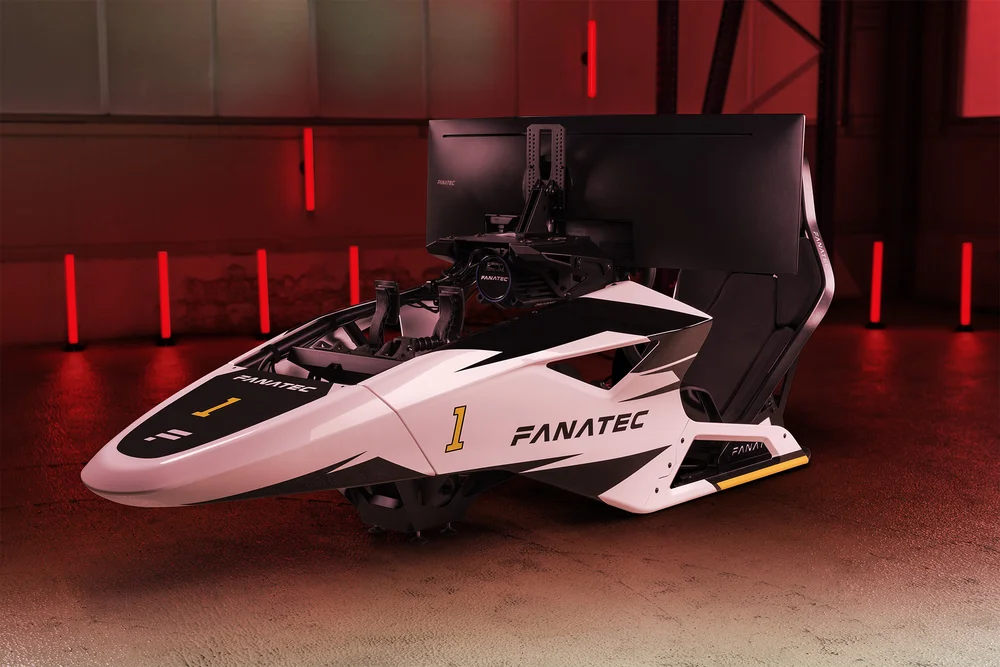
If your goal is to replicate a Formula 1 experience at home, Direct Drive is no longer optional—it is the foundation. The lightning-fast steering rack of a modern F1 car simply cannot be translated through a rubber belt. When you combine a DD motor with a dedicated Formula-style rim, everything clicks. The experience stops feeling like a “game” and starts feeling like a legitimate training tool.
CONCLUSION
Conclusion A direct drive wheel isn’t just a hardware upgrade; it’s a fundamental shift in how you experience sim racing. If you’ve ever felt like your current equipment is hiding the car’s true behavior from you, you were probably right.
Next Steps for Your Journey: If you’re still on the fence about the price tag, check out our analysis on whether a Direct Drive wheel is truly worth it for your specific needs. Ready to buy? Skip the trial and error with our curated list of the best beginner-friendly DD wheels available right now.